
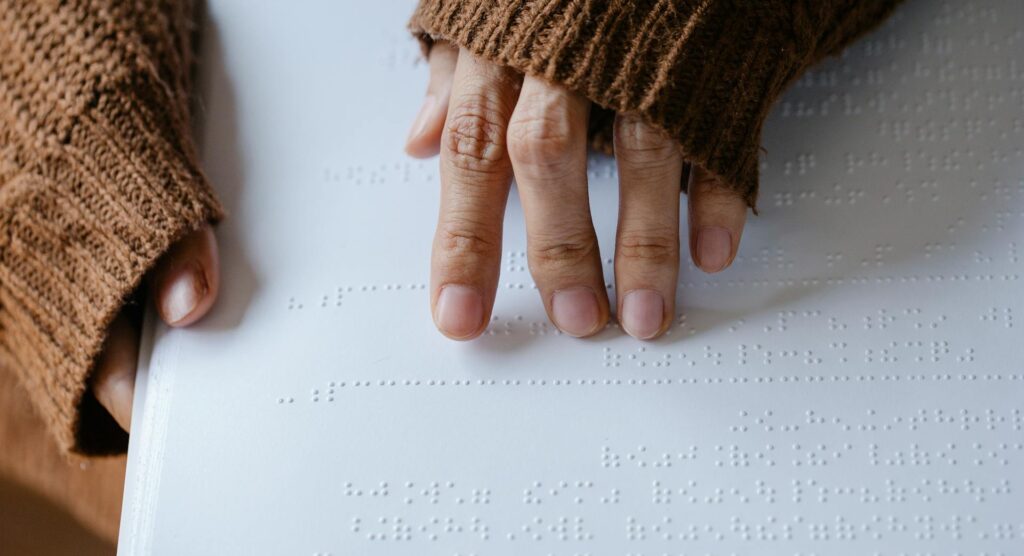
Braille is a powerful tool for literacy and independence that has transformed the lives of blind people around the world. Both print and Braille are codes that represent letters that are combined into words and sentences. Braille letters are formed with a combination of dots, and print letters are formed with lines and shapes. Each writing system serves the same essential purpose helping readers comprehend the written word.
Louis Braille, a blind teacher and musician, developed a writing system that can be read by touch, and the Braille code is named in his honor. Note that I capitalize the B in Braille as a sign of respect for him.
Louis Braille’s birthday, January 4th, marks World Braille Day, a global celebration established by the United Nations General Assembly in 2018. Many organizations also recognize January as Braille Literacy Month. I am glad to add my voice to these global celebrations of the Braille code that gives literacy to blind people who read by touch.
Braille readers learn the relationships among dots that comprise each letter, number, or punctuation symbol. The American Foundation for the Blind describes the Braille code this way. “Braille symbols are formed within units of space known as braille cells. A full braille cell consists of six raised dots arranged in two parallel rows each having three dots.” This braille alphabet and numbers page illustrates what a Braille cell looks like and the 64 possible combinations of dots used for letters, numbers and punctuation symbols. I recommend opening this link in a second tab to reference while reading my next paragraph.
Giving specific examples of how Braille letters are formed makes it easier to understand how the code works. The letter A is represented by a single dot, and that is dot one located in the top left corner of the Braille cell. The letter B (dots 1 and 2) forms a short vertical line on the lefthand side of the Braille cell. The letter C (dots 1 and 4) makes a horizontal line across the top of the Braille cell. Refer to the alphabet pictured in the referenced link for the other letters. To create Braille numbers, a special number sign, resembling the print letter L, is placed before the letters A through J, transforming them into digits 0 through 9.
The Braille Authority of North America (BANA) describes the size and spacing of Braille characters. “Braille is a fixed-width font meaning that every character occupies the same amount of space, regardless of how many dots are in the cell.”
Braille is a code that can be written in many languages. When I was a student, I learned literary Braille for reading books, and I also learned a Braille code for math called Nemeth devised by a blind math professor named Abraham Nemeth. In 2016, The English-speaking countries agreed on a standard code called Unified English Braille that has both literary and mathematical symbols. Other languages use distinct codes, and there is a separate code for musical notation. Braille is like printing with different letters, numbers, and symbols giving readers tools to study many subjects.
Braille and print transmit the same information through different sensory inputs. Braille is read with the fingers, and its compact dot arrangements fit comfortably under the fingertips. The shapes of print letters are designed to be read visually, but the large lettering on signs in public spaces can also be identified by touch.
When sighted people encounter Braille next to elevator buttons or signs, they are unable to match the patterns of Braille dots to the corresponding print letters and numbers. They might say that they are confused by Braille.
The shapes of print letters—consisting of lines, curves, and other marks—were equally puzzling to me as a child. As I wrote these print letters, I sometimes lost my sense of direction, uncertain about which curve or line I was forming, and which letter should come next.
Unlike my experience with print letters, learning to read and write Braille felt intuitive to me. I never had the sensation of losing my way as my fingers recognized the different patterns of dots that formed each Braille letter. Once I mastered the Braille letters, learning to read meant understanding that Braille letters formed words, and words formed sentences, just as my sighted classmates were learning to do with print letters.
I became an avid Braille reader easily moving my fingers from left to right across the lines of text. My knowledge of the Braille code unlocked the wonder of stories in children’s books like fairy tales or adventures. Later, I learned about the rhymes and rhythms of poetry.
A favorite childhood memory is bursting into laughter while reading Braille jokes during a long car ride. My family, curious about what was so amusing, asked me to share. I loved reading aloud to them. Usually, they read and described comics to me, but for one moment in time, I was the storyteller making them laugh.
Reading Braille makes me literate. As I write, I can review what I have written, and I can change it in the middle of a word or sentence. This is a valuable skill that I used to take for granted. Later, I learned that many blind children do not receive instruction in Braille, making them functionally illiterate through circumstances beyond their control. The shortage of Braille instructors in the United States is documented in a report titled The Braille Literacy Crisis in America.
The report also highlights a significant issue: some school administrators mistakenly believe that Braille can be replaced by audio formats. This misconception is comparable to suggesting that sighted people no longer need to read print simply because they can watch videos.
Braille allows blind people to access written language in a way that is equivalent to print, fostering true literacy and greater independence. Early proficiency in braille improves academic outcomes, highlighting the importance of braille literacy in educational achievement. Knowledge of Braille is also a factor leading to success in employment.
As an adult, I rely on Braille for reading books and completing a wide variety of daily tasks. I can write notes with important phone numbers or make my grocery list. I consult a Braille cookbook while making a new recipe.
Check out the Braillist Foundation’s media page for recordings of presentations and downloadable handouts about using Braille on the internet, in the kitchen, and everywhere.
Filing is an essential use of Braille because I write Braille labels on envelopes that contain documents written in print. These include tax returns and legal or medical records. With a filing system in place, I can identify and organize these important papers without asking for assistance each time that I need to retrieve an important document.
Sometimes, I write Braille notes on paper using mechanical devices like a slate and stylus, (like pencil and paper), or a Braille writer (like a typewriter). At other times, I write Braille electronically by connecting a refreshable Braille display to my phone or computer. The print appearing on screen is translated into Braille characters read on a second device. I know that my sighted family and friends also write print mechanically, with pens and pencils, and electronically with phones, tablets, or computers. You can see pictures and learn more about reading and writing Braille from this blog post.
Braille literacy is strongly associated with improved employment outcomes. Research indicates that people who read braille on a weekly basis or more are significantly more likely to be employed, and historically, blind adults who learned braille have enjoyed higher employment rates and greater earnings compared to those who did not. Statistics about Braille literacy at work reinforce this connection: approximately 90% of employed blind people are braille readers, but only 33% of non-braille readers are employed. Mastering Braille equips blind people with essential job skills and boosts their productivity, making Braille literacy a driving force in achieving career success.
Braille Literacy Canada compares the invention of Braille to the invention of the printing press. Today, “blind people are lawyers, politicians, programmers, journalists, clergy, teachers, authors, philosophers, musicians, linguists, theologians, scholars; and all these professions are within our reach, not solely because print-reading people grant us access to them, but because we ourselves are literate and can process the same written record as our peers.”
Braille literacy is both a means of reading and writing, and a powerful tool that offers full participation in society. Knowledge of Braille unlocks written language leading to success in our personal and professional endeavors. As we celebrate Braille Literacy Month and honor Louis Braille’s enduring legacy, let us recognize the urgent need to ensure that all blind people have access to quality Braille instruction. By supporting Braille education and advocating for greater resources, we empower the next generation of blind children and adults to claim their rightful place as literate members of society.